Innovation drives breakthrough solutions where creativity meets knowledge. We are frontrunners transforming energy management, optimization, and trading through
Cleanwatts Digital manages the complete R&D lifecycle from planning to market deployment.
Our dedicated Innovation team delivers 100% commitment to developing advanced products, solutions, and architectures that support cutting-edge research programs.
ILLIANCE is a large-scale collaborative innovation agenda funded under Portugal’s Recovery and Resilience Plan (PRR), bringing together industry, research organisations and technology providers to accelerate the transition towards carbon-neutral, healthy and energy-efficient buildings.
The project focuses on the development and industrialisation of new products, technologies and digital platforms that improve energy efficiency, indoor comfort and sustainability in the built environment.
Within this framework, Work Package 3 – Energy Management IoT Platform develops advanced solutions for intelligent energy management in buildings.
The ATE Agenda is a flagship project in Portugal funded by the PRR, with the aim of accelerating the transition to cleaner energy and promoting business innovation in the energy sector.
Led by EFACEC, the consortium brings together 80 promoters who work together to generate high added-value activities, create skilled jobs and strengthen Portugal’s international competitiveness.
Within this context, Cleanwatts Digital (CWD) plays a central role in TA02-WP3 – Energy Communities and Microgrids, in partnership with GALP and INESC-TEC, developing advanced digital solutions that enable the intelligent management of Renewable Energy Communities (REC), optimising distributed energy resources from residential and public entities.
NGS-BATFLEX aims to develop next-generation energy storage solutions, focusing on transforming batteries into flexible assets within modern energy systems.
The project covers the entire battery value chain, from components and packs to integration into distributed energy systems, demonstrating storage services that increase the integration of renewables, the flexibility of the electricity system and the overall efficiency of the grid.
The transformation of the energy sector presents significant challenges in ensuring supply security and increasing flexibility on the demand side, in order to enable the integration of distributed renewable energy generation. Energy flexibility consists of enabling the dynamic adjustment of consumption to respond to energy needs where and when they are required.
It is essential to develop the necessary technology to automatically optimize the matching between supply and demand, ensuring the stability of transmission and distribution systems while reducing energy costs.
Scaling Super HEERO (SSH) is an initiative aiming to replicate and scale community-driven energy efficiency and clean energy initiatives across multiple sectors, including shopping centres, schools, public buildings, hotels, and energy communities.
SSH operates at the intersection of technical solutions, digital enablement, and citizen engagement, leveraging the connection between buildings and their users to generate new value streams.
COALESCE aims to develop innovative approaches for the joint optimisation of data networks and energy systems, supporting the digitisation of sustainable communities. The project focuses on integrating green communication infrastructures with renewable-powered microgrids, addressing the growing energy demands of digital technologies while contributing to the twin green and digital transitions.
DEMFLEX is a two-year international innovation project focused on demonstrating how artificial intelligence can enhance energy flexibility in decentralized energy environments.
Positioned within the battery and flexibility management domain, the project explores the application of AI-driven analytics and optimization to improve the operational performance of distributed energy resources and flexibility assets.
By combining digital intelligence with flexibility orchestration, DEMFLEX aims to unlock additional value streams from distributed assets while supporting grid efficiency and renewable integration.
The project brings together leading research institutions, technology providers, and energy companies across Europe to develop advanced digital tools, artificial intelligence solutions, and user-centric interfaces that simplify energy management and unlock new flexibility services.
These innovations will be demonstrated and validated through six Living Labs across Europe (Portugal, Belgium, Italy, Ireland, Greece, and Denmark), representing diverse regulatory environments, climatic conditions, and consumer profiles.
The project aims to simplify and accelerate the development, deployment, and lifecycle management of software for Internet of Things (IoT) devices. As distributed hardware–software systems become increasingly interconnected through sensors, edge devices, and cloud platforms, ensuring security, performance, and efficient software updates becomes critical.
The project aims to revolutionise how Renewable Energy Communities (RECs) operate by introducing a transactional energy model that enhances profitability, social inclusion, and technological innovation.
The MAST – Managing Sustainability Tradeoffs project addresses a critical challenge in modern software-intensive systems: balancing different dimensions of sustainability in digital infrastructures.
As software systems grow in complexity, development teams must increasingly reconcile conflicting priorities between maintainability, performance, energy efficiency, and carbon footprint. Optimizing one of these aspects can often negatively impact another, creating difficult trade-offs for system architects and developers.
The project aims to develop a new generation of Digital Twins for complex industrial systems, enabling earlier and more reliable verification and validation during system design and deployment.
OPEVA aims to accelerate the adoption of electric vehicles (EVs) by addressing key barriers such as range anxiety, charging availability, charging duration, and operational costs.
The project explores how collaboration between multiple actors in the mobility and energy ecosystem—including EV manufacturers, infrastructure providers, software platforms, and grid stakeholders—can improve electric vehicle autonomy and energy efficiency.
FlexUnity aims to provide advanced tools and services to address the challenges of the energy transition. Its outcomes will support RES penetration, while ensuring grid stability and lower balancing costs, improving energy efficiency for end-users and increasing investments in self-generation, storage and load management. This will create more opportunities for consumers to capture value from their energy assets.
FlexUnity’s main goal is to develop and validate the VPP digital tools based on advanced Artificial Intelligence, remote automatization and blockchain. These digital tools will be used to to optimize community energy flexibility, match consumer’s energy needs, ensure further development of RES, optimize distributed energy resources, and contribute to the current energy security and climate change challenges, while enhancing retailers and aggregators competitive advantage.
This project has received funding from the European Union’s Horizon 2020 research and innovation programme under grant agreement No 870146.
inteGRIDy
Integrated Smart GRID Cross-Functional Solutions for Optimised Synergetic Energy Distribution, Utilisation & Storage Technologies
inteGRIDy (H2020) aimed to integrate cutting-edge technologies, solutions and mechanisms in a scalable Cross-Functional Platform. This platform connected energy networks with various stakeholders, facilitating optimal and dynamic operations of the Distribution Grid (DG), fostering the stability and coordination of distributed energy resources, and enabling collaborative storage schemes within an increasing share of renewables.
inteGRIDy aimed to:
Integrate innovative smart grid technologies, enabling optimal and dynamic operation of the distribution system’s assets within high grid reliability and stability standards;
Validate innovative Demand Response technologies and relevant business models;
Utilise storage technologies and their capabilities to relieve the DG and enable significant avoidance of RES (Renewable Energy Sources) curtailment, enhancing self-consumption and net metering;
Enable interconnection with transport and heat networks, forming Virtual Energy Network synergies ensuring energy security;
Provide modelling & profiling extraction for network topology representation, innovative DR mechanisms and Storage characterisation, facilitating decision making in DG’s operations;
Provide predictive, forecasting tools & scenario-based simulation, facilitating an innovative Operation Analysis Framework;
Develop new business and services to create value for distribution domain stakeholders and end users/prosumers in an emerging electricity market.
The inteGRIDy approach was deployed and validated in 6 large-scale and 4 small-scale real-life demonstration covering different climatic zones and markets with different maturity. The project started in November 2016 and ended in January 2021.
This project has received funding from the European Union’s Horizon 2020 research and innovation programme under grant agreement No. 731268.
DOMINOES
Smart Distribution Grid: a Market Driven Approach for the Next Generation of Advanced Operation Models and Services.
This European research project was supported by Horizon 2020, in which we worked with Empower (coordinator – Finland), EDP (CNET and EDP Distribution), ISEP (GECAD), Lappeenranta University of Technology – LUT (Finland), Queens University of Belfast (UK) and University of Seville (Spain).
The DOMINOES project aimed to enable the discovery and development of new demand response, aggregation, grid management and peer-to-peer trading services by designing, developing and validating a transparent and scalable local energy market solution. The project aimed to show how DSOs can dynamically and actively manage grid balance in the emerging future where microgrids, ultra-distributed generation and energy independent communities will be prevalent.
The project aimed to establish solutions to this challenge by addressing the following steps:
Design and develop a local energy market architecture;
Develop and demonstrate ICT components enabling the local market concept;
Develop and demonstrate balancing and demand response services supporting the local markets;
Design and validate local market enabled business models;
Analyze and develop solutions for secure data handling related to local market enabled transactions.
The project delivered:
New business models for demand response and virtual power plant (VPP) operations;
Tools and technology validation for demand response services;
Services based on smart metering;
Methods to utilize VPPs and microgrids as active balancing assets;
Secure data handling procedures in local markets.
These results were validated in three validation sites in Portugal and Finland: a DSO environment in Évora (Portugal), a VPP site distributed across bank branches in Portugal and a microgrid site in Lappeenranta (Finland).
Cleanwatts was the technology partner, contributing with its expertise in the development of:
Platforms for operating virtual power plants and microgrids;
Platforms for managing and forecasting demand response resources;
Mobile end-customer solutions for participation in demand response and virtual power plants;
Ensuring secure customer transactions.
The project lasted for three and a half years from October 2017 until June 2021.
This project has received funding from the European Union’s Horizon 2020 research and innovation programme under grant agreement No. 771066.
NetEffiCity
Project #18015
Support in the scope of the Incentives for Research and Technological Development (SI R&D) system – Copromotion Proj.
NetEffiCity – Virtual Power Networks Efficient Management (PT2020)
Total Eligible Cost: 274.254,37 €
EU funded support: 151.803,63 €
Project overview: This project intends to validate and demonstrate, on a large scale, previously developed technologies in R&D activities, that increase energy efficiency in buildings by reducing energy consumption during the most expensive periods and optimizing available energetic resources management. It also aims to increase consumers’ energy independence by using global management tools for decentralized production.
Energy and environmental monitoring solutions as well as remote control solutions for electrical devices will be applied. These devices will be managed by a centralized software platform, responsible for the acquisition, validation and storage of the collected data, for further processing and decision support techniques application based on neural networks and learning capacity. This platform will inform users about their consumption profiles, through graphical interfaces specially designed for the different users’ categories, to allow a more rational use of energy.
The demonstrator will also allow the creation and testing of new and more efficient business models, exploring to the maximum the demonstrated solutions’ potential and leverage the internationalization strategies of the business promoters.
Cleanwatts, as the main promotor of this project that started in September 2016, has developed the Community S concept to better connect the people who will benefit from the project and its objectives.
Kiplo STEP
Smart Transactive Energy Platform
The platform introduces automated mechanisms that simplify the end-users’ interactions with:
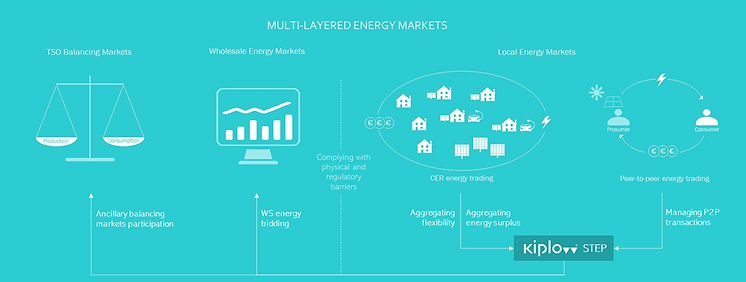
Local energy markets between different members in the energy community providing more transparency and accessibility to them; Upstream markets (or multi-layered energy market), allowing them to have a very active role responding to market requests, complying with physical, legal and regulatory barriers and framework, exploring new business opportunities related with the energy flexibility of small loads, promoting the reduction of energy bills, maximizing renewables integration, providing ancillary services while assuring a quality and security of supply.
Kiplo® STEP, will be an end-to-end platform that connects consumers, prosumers and aggregators enabling new business models and fostering local energy markets and energy communities.
The Kiplo STEP project acknowledges the cooperation of Tiago Fonseca from ISEP, whose Master’s thesis on optimization algorithms topic was developed under and contributed to the Kiplo STEP project.
If you wish to view the Kiplo STEP closing webinar, access the presentations, or visit the demo site, please contact mail@cleanwattsdigital.com.
It is a project supported by the Horizon Europe under the EIC Accelerator Seal of Excellence scope, by the call Aviso N.º 18/SI/2020 (SI-47-2020-18)
GRETA
Project overview
We are GRETA, a project that paves the path to active energy citizenship and communities. Energy citizenship means that every one of us can use energy in a sustainable way and participate in the energy transition. The challenge The EU aims to reach climate neutrality by 2050. This goal can only be achieved if citizens are given equal opportunity to take action towards it.
Energy citizenship Energy citizenship means that every one of us can use energy in a sustainable way to move towards active participation in the energy transition.
The project GRETA studies the social side of the energy transition. We want to understand how energy citizenship works in different contexts and geographical levels. What kind of knowledge, social structures, technology or financial resources are needed to make an active energy citizen?
Case studies From 2021 to 2023, we will be working with energy communities in Germany, Italy, the Netherlands, Portugal, and Spain. Citizens in these communities will adopt renewable energy, use electric vehicles, monitor their energy consumption and participate in the sustainable planning of mobility both within their cities and internationally.
GRETA will also launch a first-of-its-kind EU-wide empirical citizen consultation. Our survey will be sent to energy customers, suppliers, intermediaries, retailers and policymakers in 25 countries, driving unique insights about the emergence of energy citizenship.
Objectives GRETA studies solutions and provides recommendations on how to achieve civic energy empowerment through energy citizenship. The project has five objectives:
To understand who energy citizens are.
To understand how energy citizens act and interact.
To develop and test behavioural strategies, approaches and models for facilitating energy citizenship.
To realize impact by scaling approaches from local to regional, national, and supranational levels.
To improve the policymaking process.
This project has received funding from the European Union’s Horizon 2020 research and innovation programme under grant agreement No. 101022317.
Sflex
Project number 45405 Sflex
Support in the scope of the Incentives for Research and Technological Development (SI R&D) system – Individual Proj.
Sflex – Small Loads flexibility management
Total Eligible Cost: 478.624,37 €
EU funded support: 300.934,83 €
Project overview
Because of the transformation of the electric sector the costs of management and balance of the grids are increasing, which are reflected later in the customer tariffs. Solutions based on the technological advances in the ICT field are allowing the implementation of Intelligent Energy Networks and new demand management mechanisms, with an increasing potential to guarantee grid balance, but are still significant economic barriers for wider deployment (for inclusion of small energy loads).
The sFlex project – Flexibility management of small loads aims at developing an intelligent flexibility management platform that allows a use of flexibility from small loads focused on benefits to both Smart Buildings and Smart Grids, allowing a reduction of imbalances in grid balancing, reducing energy costs in buildings, maximizing the use of renewable energy, and enhancing new revenues with the use of flexibility. It will act in three distinct areas that reflect the innovation approach of this project:
Reducing costs of flexible load control management systems – Developing a low-cost universal IR control to manage the flexibility of consumption associated with houses and offices heating/ cooling with distributed HVAC systems.
Reducing operational costs of optimization management of distributed resources – Developing a flexibility optimization module with dynamic optimization rules and learning based on context and an predictive control model for HVAC equipment, expandable to other flexible loads.
Creating of added value with flexibility aggregation / disaggregation – Developing flexibility aggregation models for small loads to use in balancing and demand response markets, and development of a multi-criteria scheduling algorithm.
Location: Coimbra
This project has received funding from the European Union’s Horizon 2020 research and innovation programme under grant agreement No 957810.
IANOS
A STRONG DECARBONISATION STRATEGY There are more than 2,700 islands all over Europe and every island has its own conditions. That is why the IANOS project aims at tailor-made solutions.
IANOS selected the islands of Ameland (Netherlands) and Terceira (Portugal) to serve as “pilot islands” because they both represent common EU challenges in terms of energy requirements, population, climatic conditions and topographic characteristics. The islands also offer various large-scale storage solutions for renewable energy sources and differ in their market characteristics, policies and regulations around the storage of energy. Considering their different penetration levels of renewable energy and grid conditions, they also represent different technical challenges.
The IANOS project also includes three “Fellow Islands” to validate the replicability potential of the results of the pilot islands. The islands selected are Lampedusa (Italy), Bora Bora (French Polynesia) and Nisyros (Greece).
VIRTUAL POWER PLANT BASED ON ARTIFICIAL INTELLIGENCE A Virtual Power Plant (VPP) is a cloud-based cluster of intermittent energy generators such as wind turbines, solar panels, power-to-x facilities, vehicle-to-grid facilities, etc. that can be controlled from a central point. IANOS will demonstrate a VPP that uses Artificial Intelligence (AI) to optimise the generation of energy and balance demand and supply of energy on the islands. The AI is based on meta-learning predictive methods, fog computing, and a smart grid/advanced metering infrastructure integration to maintain stable system operation by taking into account several uncertainties and technical constraints such as ramp-up and down times, and compensating imbalances within various timeframes.
The core functionalities of the VPP include:
Efficient forecasting of renewable energy sources uncertainties and demand profiling through novel meta-learning, AI-based predictors and incorporating physical and statistical models based on the specified response-to-accuracy ratio;
Local-to-global energy assets’ management, through the use of edge-to-cloud infrastructure to deliver intelligence at low voltage prosumers and empower the local energy communities towards self-consumption and tackling local-to-regional area supply and demand balancing;
Incorporation of transactive mechanisms based on DLTs and smart contracts to support energy credits’ exchange between prosumers, aiming at enhancing transparency, immutability and localised energy balance incentivisation (also enabling prosumers’ active participation in flexibility services.
INNOVATIVE TOOLS SUPPORTING GREENER INVESTMENTS The IANOS Energy Planning and Transition Suite will assist key island stakeholders, such as energy system planners, utility owners and public authorities, in developing an effective renewable energy portfolio and island decarbonisation plan.
The main elements are:
• A crowd equity platform to promote collaborative investments and co-ownership of renewable energy assets for citizens and island stakeholders; • A dedicated Life Cycle Assessment (LCA) toolkit to further assist in the decision making process: large prosumers groups will be grouped together and be able to optimise their environmental impact through LCA analysis, and increase potential economic benefits by minimising energy costs; • A grid-oriented optimiser, providing detailed modelling and grid scenarios simulations to examine the transient performance and network constraints per scenario given.
PEOPLE AS ACTIVE PLAYERS IN THE ENERGY SYSTEMS The community and islander-centric approach of IANOS is based on two main axes:
Active participation of citizens through the deployed ICT solutions (promoting crowdfunding for renewable energy investments, exchange of energy credits on established bilateral prosumer contracts, participation in implicit and explicit demand-response schemes, exchange of information on sustainable energy themes); Social engagement program led by the local Island authorities, to take into account critical feedback from islanders on the new investments.
This project has received funding from the European Union’s Horizon 2020 research and innovation programme under grant agreement No. 957810.
me²
me² represents a new market place for urban actors in which a local community of electric vehicle (EV) users and local smart meter (SM) owners are brought together through means of a local urban online community. The combination of these technologies in a community allows to integrate mobility with electricity, to balance the grid, to reduce electricity costs, and to enable a feeling of local belonging. me² enables urban demand-side management, i.e. aims to modify consumer demand for energy such as using less energy during peak hours in an urban community.
Expected Results:
Smart City Aggregator platform;
Pilots in a city with high degree of EV adoption (Amsterdam) and in a city with a lower degree of EV adoption (Lisbon);
Increased understanding and integration of e-mobility and electricity behaviour, developing mechanisms to influence these behaviours using gamification elements based on smart algorithms;
Mechanisms to balance local grids, defined in a 10% smoothened load curve;
Lowered average energy costs for consumers, defined in 10% lower energy costs;
A policy recommendation;
A viable business model.
AESOP
Project #40004
Support in the scope of the Incentives for Research and Technological Development (SI R&D) system – Co-promotion Project.
AESOP – Autonomic Service Operation
Total Eligible Cost: 109.698,37 €
EU funded support: 79.115,75 €
Project overview
For business services to function correctly today, software solutions deployed to any cloud provider need to maintain proper availability and performance levels. Although there are currently several different approaches and tools that monitor technical parameters, these are not enough for monitoring business levels. Therefore, there is a gap between what can be monitored and observed and what the business needs.
To overcome this gap, this project aims to develop a new platform that allows to specify a set of business parameters, while those parameters are part of a feedback adaptive loop that can actuate on those applications and its infrastructure beneath.
This feedback loop will take advantage on virtualized infrastructure, built on infrastructure-as-code principles that are to extended to address the business level needs. For this purpose, we need to make an explicit definition on what those business levels are, both during development cycle and operation cycle.
To achieve this overall goal, we built a 3 company consortium, where University of Coimbra will bring the ability to research and explore new algorithms for adaptive detection and predictive actuation; Cleanwatts will bring the overall real world information from the industry and Fiercely will work for integrating the different views and technologies in order to guarantee the holistic view on business performance.
Location: Coimbra
Flexigy
Project #034067
Support in the scope of the Incentives for Research and Technological Development (SI R&D) system – Co-promotion Project.
Flexigy – Energy Flexibility Services Platform
Total Eligible Cost: 1.055.557,57 €
EU funded support: 668.538,32 €
Project overview
R&D focuses on three main challenges:
1. How to overcome regulation barriers to deploy balancing and flexibility services
The consortium will create an Energy Virtual Community concept that will operate behind the meter overcoming the legal barriers. The services will be developed in a way that the aggregator will engage energy assets with private bilateral contracts that will allow the use of distributed energy resources in a collaborative approach so that the benefit from the contribution of all community will be significant higher than the individual optimization of energy assets.
2. How to gain end-user trust to participate
We will implement Blockchain technology in the community platform to increase trust and help with the virtual energy transactions management.
3. How to operationalise community optimization mechanisms
We will develop the Cyber-physical components that will ensure the reliability of the system complying with the needed low cost requirement to be economically viable.
Key outputs:
Development of load management flexibility services
Development of distributed thermal storage flexibility services
Development of distributed batteries storage flexibility services
Development of virtual energy transaction management system
Location: Coimbra
SMART-PDM
Project number POCI-01-0247-FEDER-040123
Lisbon-01-0247-FEDER-040123
Project Name: Smart-PDM – A Smart Predictive Maintenance Approach Based on Cyber Physical Systems
Support in the scope of the Incentives for Research and Technological Development (SI R&D) system
Main Goal: To bolster investigation, technological development and innovation.
SMART-PDM’s objective is to acquire manufacturing data to provide diagnosis and prognosis information while rendering the underlying technology financially feasible.
In order to achieve this goal, we created a very complementary and conducive consortium with 13 use case demonstrators with a consortium formed by 6 integration & tools providers and 14 technology and knowledge providers all waiting to test out and further improve their technologies, with a balanced breakdown of 12 SMEs, 9 large organizations, 7 RTOs, and spread across 6 countries.
The Portuguese part of this project is structured upon a use case related with after sales support in retail operations of domestic appliances with special emphasis on the creation of new services for the predictive maintenance of domestic equipment as a differentiator factor for the business.
Predictive maintenance challenges are reflected in the project SMART-PDM, where the companies intend to improve the OEE (availability, performance, and quality) to provide better products and services, reducing costs, increasing profitability and associated security. Diagnostic and prognostic actions allow machines or processes to be maintained in good conditions, provide more precise knowledge concerning the occurrence of failures and provide instructions on how to keep the equipment in optimum condition, or How to fix them. On the other hand, the servitization of maintenance and other marketing strategies will be considered in order to provide a greater added value to customers, retailers and producers of equipment, taking advantage of the potential savings offered by prognostic techniques, a relatively new area, which became an important part of maintenance systems.
Cleanwatts as a fundamental part of the project
Cleanwatts’ role covers all phases of the SMART-PDM project. Cleanwatts’ commitment includes:
Develop a smart plug prototype, capable of identifying failures and providing metrics that allow preventive maintenance
Develop an intelligent platform capable of implementing advanced data analysis techniques, with the objective of detecting failures and identifying the need for preventive maintenance actions
Interface development
For the end user
For the retail user
And an API to provide data to other external platforms (e.g. retailer’s breakdown management platform)
To know more about SMART-PDM please visit the project’s website athttps://smart-pdm.eu/.
Location: Coimbra
European Data Incubator (EDI)
Project overview
Only 2 out of the top 20 companies changing lives and making money out of Big Data are European. Europe is not playing the role it should in the global market.
European Data Incubator (EDI) project aims to revert this situation. Every company is born as a startup, and Big Data has already proven to be a disruptive technology that can provide substantial changes in traditional and innovative domains.
Many SMEs are facing a number of problems when attempting to develop a sort of comprehensive data strategy. The tools required to make successful data management an achievable prospect often require an up-front capital investment. The data remains in silos and its availability or cross-domain value is still unperceived. EDI will help them jump this hurdle providing:
a free infrastructure with open source tools
training on the most known off-the self solutions
support and business services to develop their business idea and equity-free funding
The main objective of the project will be to leverage the technology and knowledge on Big Data across countries and sectors thanks to the incubation of start-ups/SMEs who use Big Data open source tools oriented to sort out major challenges in different business which facilitate their data assets. An experienced consortium will be behind EDI. It is comprised by experts on Big Data technologies, the managers of several acceleration initiatives within the FIWARE Accelerate programme, existing incubators like Deusto Entrepreneurship Centre and etventure Seed Lab and the largest online network for start-ups (F6S).
Moreover, 16 data providers, from Finance, Transport, Industry 4.0, Retail, Media&Content, Energy, etc. will provide data to the incubation process. We expect to incubate around 120 companies under a 3-phase incubation programme (funnel approach) launching 3 call for proposals and disbursing up to €5M equity-free and commiting to raise additional financing resources up to €15M for them from private investors mainly.
This project has received funding from the European Union’s Horizon 2020 research and innovation programme under grant agreement No. 779790.